


About UNMEASURED
About UNMEASURED: a research project and collaborative network co-funded by the EU via the Agroecology Partnership and national funding partners.
The project runs for 36 months, from April 2026 to March 2029, with a total budget of EUR 2.3 million.
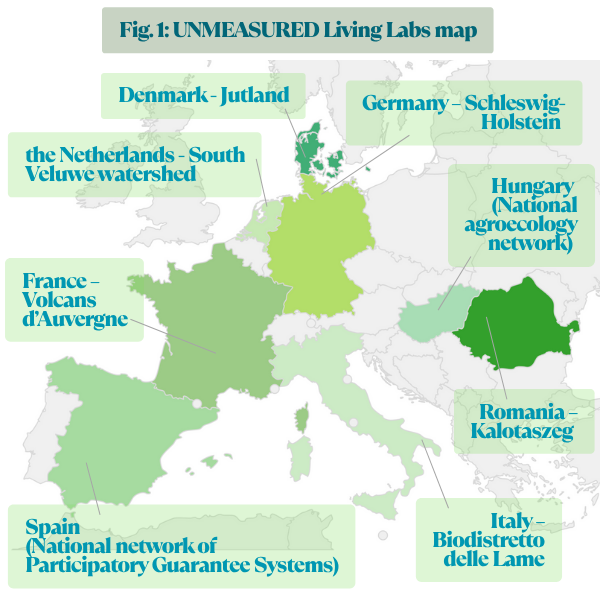
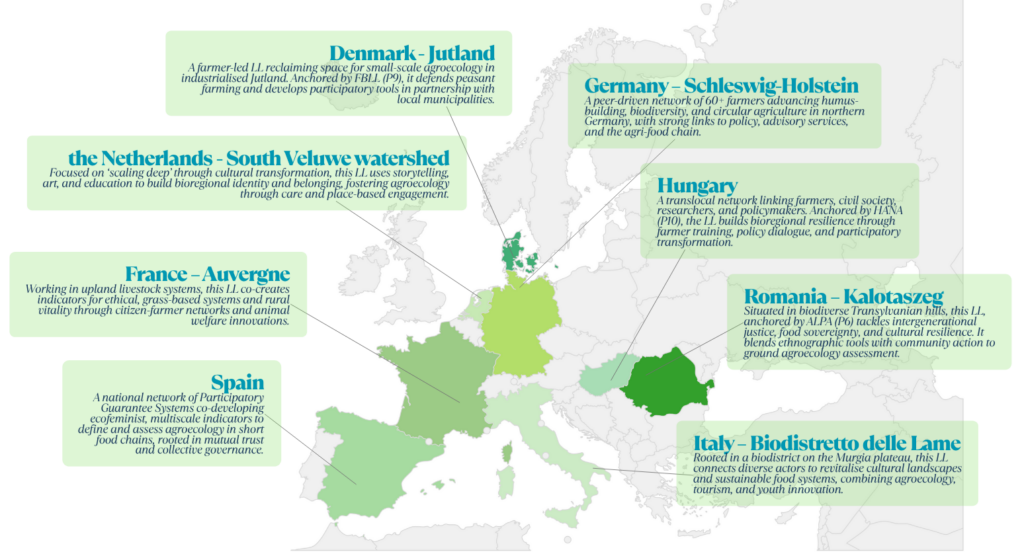
UNMEASURED is coordinated by Nina Isabella Moeller at the University of Southern Denmark (SDU), and brings together research institutions, farmers associations and civil society organisations in territorial networks (or “Living Labs”) across eight countries:
UNMEASURED is concerned with everything that is rendered invisible within the metric, quantitative and reductionist paradigm, yet remains important—perhaps essential—to the green transformation of agriculture and society.
We take a critical interest in qualitative aspects; social, cultural, spiritual and other value-bearing dimensions; “warm data”; and other forms of knowledge and experience that cannot easily be measured or weighed. We also attend to all that which, in practice, holds a system together and provides the grounding for collective agency in processes of change.
- Syddansk Universitet (SDU), Denmark
- Cordoba Universitet, Spain
- Wageningen Universitet, The Netherlands
- Thuenen Institut, Germany
- RESEAU INTERNATIONAL URGENCI, France
- ALPA – Land for Life, Romania
- INRAE, France
- CIHEAM IAMB, Italy
- Frie Bønder – Levende Land, Denmark
- Hungarian Agroecology Network Association, Hungary
If you would like to know more about UNMEASURED, or perhaps take part, offer input or constructive critique, please write to Nina.
~ see also the Danish language website ~
UNMEASURED will develop better ways of working with that which often falls outside standard measurement, simple quantification and reductionist indicators. The project starts from the premise that important aspects of agroecological transformation cannot always be reduced to numbers, indicators and simple comparisons. It will therefore strengthen existing assessment frameworks by integrating qualitative, participatory and context-sensitive methods, making social, cultural and ethical dimensions more visible and more usable in practice. For example:

UNMEASURED focuses on what is often difficult to measure, yet crucial to agroecological transformation. This includes social cohesion, relations of care, mutual aid, food sovereignty, knowledge sovereignty, cultural resilience, traditional knowledge, intergenerational justice, social justice and resilience in times of crisis.
Rather than rejecting quantitative measures, UNMEASURED works to ensure that they are complemented by methods better able to capture what otherwise disappears within standardised evaluation systems.
In this sense, UNMEASURED is concerned both with better knowledge and with fairer foundations for decision-making in agroecology.
In concrete terms, the project will identify gaps in existing agroecological assessment tools, co-create new qualitative indicators and participatory evaluation instruments, develop decision-support approaches that make trade-offs and value conflicts visible, and test all of this in Living Labs across different European contexts.
UNMEASURED thus builds a bridge between standardised measurement and local, experience-based knowledge.
The ambition of UNMEASURED is to make agroecological design and evaluation more holistic, more democratic, more epistemically just, and more useful for community building, practice, research and policy.
UNMEASURED works through a Living Lab approach in which farmers, civil society, researchers and other actors take part in the joint development and testing of new tools. Living Labs are understood as co-creative spaces for learning, reflection and territorial transformation. The project includes Living Labs and territorial agroecological networks in Denmark, France, Germany, Hungary, Italy, the Netherlands, Romania and Spain.
This gives UNMEASURED a strong transnational foundation for developing methods that are both robust and sensitive to local differences…
A central aim of UNMEASURED is to make hidden trade-offs and value conflicts in agroecological transformation more visible. This includes, for example, tensions between economic, social, cultural and ecological concerns. The project will therefore also develop decision-support tools, dialogue formats and learning instruments, including game-based and participatory methods, that can be used by practitioners, advisors, researchers and decision-makers. In this way, UNMEASURED seeks to contribute to more context-sensitive and more just transformations of agriculture and food systems.
UNMEASURED is also conceived as a project with strong public and practical relevance. Its results will be shared here on this site and at Agroecology @ SDU, as well as through social media, workshops, webinars, training materials, policy briefs and a special issue of Rooted Magazine. The project places strong emphasis on open science and on ensuring that its tools and results are accessible and useful to different user groups.
UNMEASURED is therefore not only about research, but also about strengthening broader societal understanding of the values and possibilities of agroecology.

Here are some of the sources and inspirations that underpin UNMEASURED:
- Alrøe, H. F., and E. Noe. 2014. “Second-Order Science of Interdisciplinary Research: A Polyocular Framework for Wicked Problems.” Constructivist Foundations 10: 65–76: https://constructivist.info/10/1/065
- Balogh, L., Réthy, K., and Balázs, B. 2020. Mapping Agroecology in Hungary.
- Balogh, L., Réthy, K., and Tóth, B. 2020. Az agroökológia 10 alapelve.
- Balogh, L., Réthy, K., Strenchock, L., and Szilágyi, A. 2022. Thematic Study of the BIOEAST Thematic Working Group on Sustainable Yields and Agroecology: Socio-Ecological Indicators of Agroecology Systems in the BIOEAST Countries.
- Bateson, Nora. 2016. Small Arcs of Larger Circles: Framing Through Other Patterns. Triarchy Press:
https://www.triarchypress.net/small-arcs.html - Busse, M. et al. 2024. “Conceptualizing and Reflecting Co-Design Processes for the Transformation Towards Insect-Friendly Agricultural Landscapes: Experiences from Transdisciplinary Processes in Three German Landscape Labs.” Journal of Innovation Management 12(3): 273–316:
https://doi.org/10.24840/2183-0606_012.003_0011 - Chen, Y. et al. 2022. “Winegrowers’ Decision-Making: A Pan-European Perspective on Pesticide Use and Inter-Row Management.” Journal of Rural Studies 94: 37–53: https://doi.org/10.1016/j.jrurstud.2022.05.021
- Creswell, John W. 2013. Qualitative Inquiry and Research Design: Choosing Among Five Approaches. 3rd ed. SAGE:
https://books.google.dk/books?id=Ykruxor10cYC - Espeland, Wendy Nelson, and Mitchell L. Stevens. 2008. “A Sociology of Quantification.” European Journal of Sociology 49(3): 401–436: https://doi.org/10.1017/S0003975609000150
- Forum for Food Sovereignty. 2017. Food Sovereignty: Who Can Make Decisions over Our Food? Forum for Food Sovereignty.
- Gava, O. et al. 2025. “Governance Networks for Agroecology Transitions in Rural Europe.” Journal of Rural Studies 114: 103482:
https://doi.org/10.1016/j.jrurstud.2024.103482 - Geertz, Clifford. 1973. The Interpretation of Cultures: Selected Essays. Basic Books:
https://books.google.com/books/about/The_Interpretation_Of_Cultures.html?id=BZ1BmKEHti0C - Haraway, Donna. 1988. “Situated Knowledges: The Science Question in Feminism and the Privilege of Partial Perspective.” Feminist Studies 14(3): 575–599: https://doi.org/10.2307/3178066
- Harding, Sandra. 1991. Whose Science? Whose Knowledge?: Thinking from Women’s Lives. Cornell University Press:
https://www.cornellpress.cornell.edu/book/9780801497469/whose-science-whose-knowledge/ - Kimmerer, Robin Wall. 2013. Braiding Sweetgrass: Indigenous Wisdom, Scientific Knowledge and the Teachings of Plants. Milkweed Editions: https://milkweed.org/book/braiding-sweetgrass
- Latour, Bruno. 2004. Politics of Nature: How to Bring the Sciences into Democracy. Harvard University Press:
https://www.hup.harvard.edu/books/9780674013476 - Lehrmann et al. 2017. A Green and Just Food Policy. Friends of the Earth Denmark and Frie Bønder Levende Land.
- Merry, Sally Engle. 2016. The Seductions of Quantification: Measuring Human Rights, Gender Violence, and Sex Trafficking. University of Chicago Press: https://press.uchicago.edu/ucp/books/book/chicago/S/bo23044232.html
- Mol, Annemarie. 2002. The Body Multiple: Ontology in Medical Practice. Duke University Press:
https://www.dukeupress.edu/The-Body-Multiple/ - Noe, E., and H. F. Alrøe. 2012. “Observing Farming Systems: Insights from Social Systems Theory.” In Farming Systems Research into the 21st Century: The New Dynamic, 387–403:
https://doi.org/10.1007/978-94-007-4503-2_17 - Noe, E., and H. F. Alrøe. 2014. “Sustainable Agriculture Issues Explained by Differentiation and Structural Coupling Using Social Systems Analysis.” Agronomy for Sustainable Development 35: 133–144: https://doi.org/10.1007/s13593-014-0243-4
- Noe, E., and H. F. Alrøe. 2015. “Regulation of Agroecosystems: A Social Systems Analysis of Agroecology and Law.” In Law and Agroecology: A Transdisciplinary Dialogue, 31–45:
https://doi.org/10.1007/978-3-662-46617-9_2 - Peeters, A. et al. 2021. A Green Deal for Implementing Agroecological Systems: Reforming the Common Agricultural Policy of the European Union: https://doi.org/10.3220/LBF1610123299000
- Pixová, M., Spanier, J., and Guerrero Lara, L. 2024. “Building Solidarities and Alliances Between Degrowth and Food Sovereignty Movements.” Journal of Political Ecology 32: https://doi.org/10.2458/jpe.5841
- Porter, Theodore M. 1995. Trust in Numbers: The Pursuit of Objectivity in Science and Public Life. Princeton University Press:
https://press.princeton.edu/books/paperback/9780691208411/trust-in-numbers - Queiroga-Bento, R., and Ujj, A. 2022. Agroecology: Introductory Handbook for Farmers. trAEce.
- Queiroga-Bento, R., Strenchock, L., and Ujj, A. 2022. Agroecological Vocational Training Curriculum Module Summary. trAEce.
- Schwarz, G. et al. 2022. “Exploring Sustainability Implications of Transitions to Agroecology: A Transdisciplinary Perspective.” EuroChoices 21: 37–47: https://doi.org/10.1111/1746-692X.12377
- Scott, James C. 1998. Seeing Like a State: How Certain Schemes to Improve the Human Condition Have Failed. Yale University Press: https://yalebooks.yale.edu/book/9780300078152/seeing-like-a-state/
- Skotte Møller et al. 2019. Money and Political Influence. Global Aktion, Frie Bønder Levende Land, Friends of the Earth Denmark.
- Strenchock, L. 2021. “Germinating Degrowth? On-Farm Adaptation and Survival in Hungarian Alternative Food Networks.” In Food for Degrowth: Perspectives and Practices.
- Strenchock, L., Liegey, V., and Lazanyi, O. 2025. “Reimagining Collaboration: Degrowth Practitioners, Scholars and Activists.” In Routledge Handbook on Degrowth.
- van der Ploeg, J. D. et al. 2019. “The Economic Potential of Agroecology: Empirical Evidence from Europe.” Journal of Rural Studies 71: 46–61: https://doi.org/10.1016/j.jrurstud.2019.09.003
- von Gall, P. et al. “How – and How Much? An Analysis of Major Conflict Lines Regarding the Transformation of German Animal Farming.” German Journal of Agricultural Economics 73(1): https://doi.org/10.52825/gjae.v73i1.1318

This project is part of the programme of the AGROECOLOGY partnership, co-funded by the European Union’s Horizon Europe research and innovation programme under Grant Agreement No. 101132349.